Mobile Oil Change Business Software for a Solo Technician (2026)
For a solo mobile oil change technician, ShowTheReceipts ($15/mo) covers the whole stop — quote by vehicle and service, invoice the moment the drain plug's back in, and take the card in the driveway, with every vehicle's service history kept on the customer's record for the next interval.
How we picked
Entry-plan prices as published in 2026, checked against each vendor's own pricing page or a recent third-party pricing summary. We judged tools on the one-technician workflow — quote, invoice, get paid in the driveway, and track vehicle history for the next service — not on multi-bay shop or franchise features.
| Software | Starting price | Best for |
|---|---|---|
| ShowTheReceipts That's us | $15/mo | Solo technicians: on-site quote, same-day invoice, card payment, cash & Venmo tracked, tax-ready books |
| Kickserv Flex | $19/mo | Budget scheduling + invoicing, no vehicle-history or VIN lookup |
| QuoteIQ | $29.99/mo | AI estimating and automated follow-ups for repeat oil-change customers |
| Orderry | $39/mo | Vehicle records, VIN scanning, and OEM service-interval recommendations |
| Droptop | From $165/mo | Established multi-technician operations wanting a quick-lube-specific platform |
The solo technician’s real workflow
A mobile oil change stop is fast — quote, service, invoice, paid, and on to the next driveway. Your software either keeps up with that pace or it slows you down with a shop-scale workflow that was built for a bay, not a truck.

1. ShowTheReceipts — $15/mo
Quote the service by vehicle from your phone, invoice the moment the plug’s back in, charge the card before you pull away. Cash and Venmo jobs land in the same ledger as card payments, so tax season is an export instead of a shoebox. Every past service stays on the customer’s record, so you know the interval without asking.
2. Kickserv Flex — $19/mo
The proven budget pick: scheduling, customer history, and invoicing that works. There’s no vehicle-specific fields, though, so you end up tracking make and model in notes instead of a structured record.
3. QuoteIQ — $29.99/mo
The follow-up standout: AI-assisted estimating plus automated outreach when a regular customer’s mileage interval is coming up.
4. Orderry — $39/mo
Built with the automotive trade in mind: VIN scanning, vehicle records, and OEM-recommended service intervals per make and model.
Skip it if you already know your regulars’ vehicles from memory — the VIN-lookup layer is really what that extra $24 is buying you.
5. Droptop — from $165/mo
A quick-lube-specific platform priced for an established operation, usually running more than one technician. It’s just not built for a single truck that’s still getting started.
Frequently asked questions
What software does a solo mobile oil change business actually need?
On-site quoting by vehicle and service type, same-day invoicing, and on-site card payment — plus a record of what was done and when, so the next interval isn't a guess. VIN-decoding parts catalogs and multi-bay shop scheduling are features built for a quick-lube location with several technicians, not one truck doing driveway calls.
What do I get with ShowTheReceipts for $15/month?
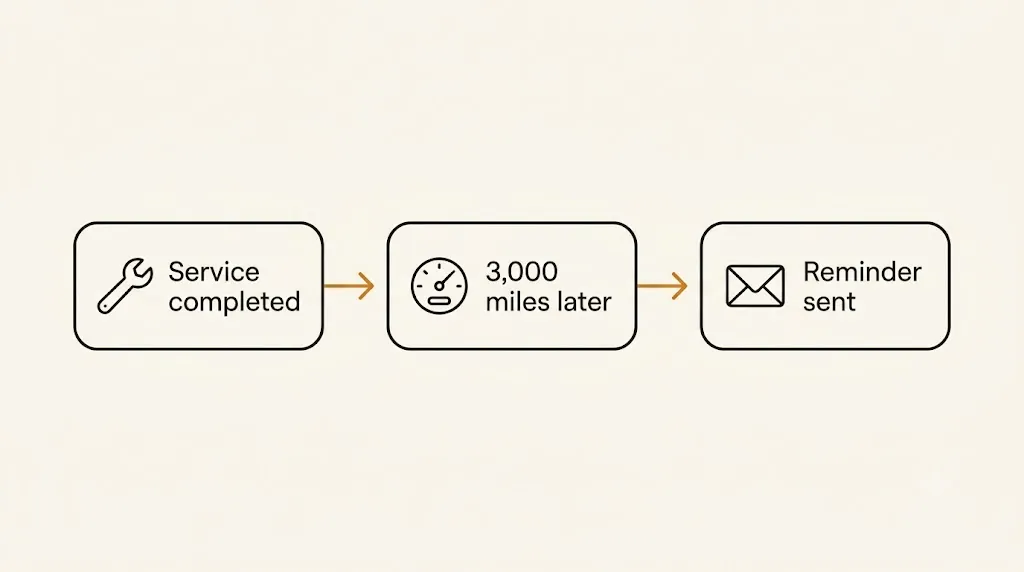
The solo-technician workflow at the lowest paid price — quote by vehicle, invoice the same visit, charge the card in the driveway, cash and Venmo tracked in the same ledger, and tax-ready exports at year end. Move up to Pro when automatic mileage-interval reminders are worth automating across a growing customer list.
Do I need VIN-scanning and OEM parts lookup for a mobile oil-change route?
Only if you're stocking multiple oil weights and filters across several vehicle makes and want the software to tell you which fits. Most solo mobile technicians already know their regular customers' vehicles by the second visit — VIN lookup earns its keep once the customer base and the parts inventory both get large enough that memory stops being reliable.